
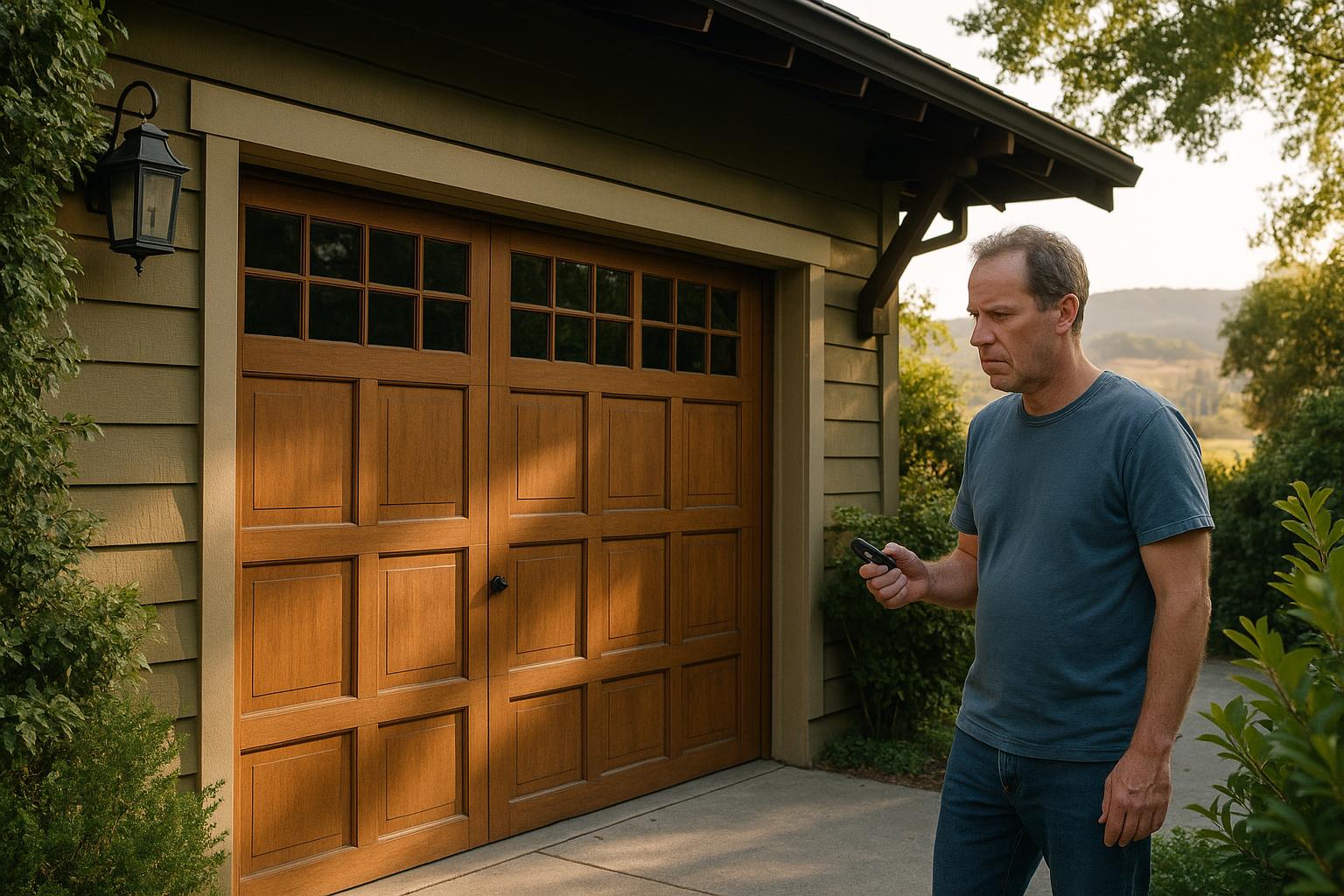
You're Running Late and Your Garage Door Won't Budge
It's a scenario that plays out in driveways across Napa every week: you press the button on your garage door opener, hear a click or a hum, and… nothing. The door stays firmly shut. Maybe it lifts an inch and drops back down, or maybe it doesn't respond at all. Either way, you're stuck — and probably already running behind schedule.
Before you panic, it helps to understand that most garage door failures have straightforward explanations. Some you can troubleshoot yourself in a few minutes, while others require a trained technician. Let's walk through the most common reasons your garage door won't open and what you should do about each one.
1. Dead Remote or Wall Switch Batteries
This is the simplest fix on the list, and it's more common than you'd think. If pressing your remote does absolutely nothing — no light on the opener unit, no sound, no movement — the batteries in your remote may be dead.
What to do: Replace the batteries in your remote and try again. If the remote still doesn't work, try the wall-mounted button inside your garage. If the wall switch works but the remote doesn't, the remote itself may need to be replaced or reprogrammed.
2. The Opener Is Unplugged or Has No Power
Power outages overnight, a tripped breaker, or an accidentally unplugged cord can leave your garage door opener completely unresponsive. This is especially common in Napa during winter storms when power interruptions are more frequent.
What to do: Check that the opener unit is plugged in. Then check your home's electrical panel for a tripped circuit breaker. If power was restored after an outage, the opener may need a moment to reset. Most modern openers also have a manual release cord — usually a red handle hanging from the track — that lets you disengage the opener and lift the door by hand so you can get your car out while you sort out the electrical issue.
3. The Safety Sensors Are Blocked or Misaligned
Every garage door opener manufactured after 1993 includes photoelectric safety sensors near the bottom of the door tracks. These sensors send an invisible beam across the opening, and if anything breaks that beam, the door won't close — and in some cases, it won't open properly either.
What to do: Look at the two small sensor units on either side of the door near the floor. Each one should have a steady light — typically one green and one amber. If a light is blinking or off, the sensors may be misaligned, dirty, or obstructed. Wipe the lenses with a clean cloth, remove any debris or cobwebs, and gently adjust the sensors until both lights are steady. In Napa's wine country environment, it's not unusual for spiders, leaves, or even vineyard dust to interfere with these sensors.
4. The Door Is Locked
Many garage doors have a manual lock — a handle or latch on the inside that slides a bar into the track. If someone accidentally engaged this lock, the opener will strain against it and fail to open the door. You may hear the motor running but the door won't move.
What to do: Check the inside of your garage door for a lock mechanism. If the lock bar is engaged in the track, disengage it. Running the opener against a locked door repeatedly can damage the opener, the lock, or the door itself, so address this quickly.
5. A Broken Torsion Spring
This is one of the most common — and most serious — reasons a garage door won't open. Torsion springs are mounted above the door and carry the vast majority of the door's weight. When a spring breaks, the opener simply doesn't have enough power to lift the door on its own.
Signs of a broken spring:
- You heard a loud bang from the garage (often mistaken for something falling or a car backfiring)
- The door feels extremely heavy when you try to lift it manually
- You can see a visible gap in one of the springs above the door
- The opener hums or strains but the door barely moves
What to do: Do not attempt to replace torsion springs yourself. These springs are under extreme tension and can cause serious injury if handled improperly. This is a job for a professional garage door technician. At Napa Garage Door Pro, spring replacement is one of our most common service calls, and we carry the most popular spring sizes on our trucks so we can usually complete the repair in a single visit.
6. The Opener's Drive Mechanism Has Failed
Garage door openers use one of three drive types: chain, belt, or screw. Over time, these components wear out. A chain can slip or break, a belt can crack, and a screw drive can strip. If you hear the motor running but the door doesn't move and the springs are intact, the drive mechanism may be the culprit.
What to do: This typically requires professional diagnosis and repair. Depending on the age of your opener, it may make more sense to replace the entire unit rather than repair a worn drive system — especially if your opener is more than 15 years old and lacks modern safety and smart-home features.
7. The Track Is Bent or Obstructed
Your garage door rides along metal tracks on either side of the opening. If a track is bent, dented, or blocked by a misplaced object, the door can jam partway or refuse to move at all. Even a small dent in the track can prevent smooth operation.
What to do: Visually inspect both tracks for obvious damage or obstructions. Minor debris can be cleared away, but bent tracks should be repaired or replaced by a professional. Forcing a door along a damaged track can cause the door to come off the track entirely, creating a much bigger — and more expensive — problem.
8. Cold Weather and Lubrication Issues
While Napa enjoys a relatively mild climate, winter mornings can still bring temperatures cold enough to thicken old lubricant on springs, rollers, and hinges. This added resistance can make it harder for your opener to lift the door, especially if the system is already borderline on power.
What to do: Apply a silicone-based garage door lubricant to the springs, rollers, hinges, and track. Avoid using WD-40 as a long-term lubricant — it's a solvent, not a lubricant, and it can actually attract more dust and grime over time. Regular maintenance, ideally once or twice a year, keeps all moving parts operating smoothly regardless of the season.
When to Call a Professional
If you've checked the basics — power, remote batteries, sensors, and the manual lock — and your door still won't open, it's time to call in a professional. Continuing to press the button or forcing the door can turn a minor issue into a major repair.
At Napa Garage Door Pro, we serve homeowners and businesses throughout Napa, American Canyon, Yountville, St. Helena, Calistoga, and Sonoma. We understand that a garage door that won't open isn't just an inconvenience — it can leave you stranded, compromise your home's security, and disrupt your entire day. That's why we offer prompt service and carry common replacement parts on our trucks to minimize your downtime.
If your garage door isn't cooperating, don't wrestle with it. Give us a call and let us diagnose the problem quickly, safely, and affordably so you can get back to your day.